
Jess Allen b.1966
Jess Allen was born in 1966 in Dorset, in the United Kingdom
Jess Allen is represented by Blue Shop Gallery
-
Jess Allen is an artist, who lives and works 'off the beaten track.' She has exhibited rarely, and her solitude from the art world, is apparent in the images she makes.
Jess Allen was born in 1966 in Dorset, in the United Kingdom. She spent most of her childhood in London, and studied Foundation at Camberwell College of Arts. After gaining a BA Honours in Fine Art at Falmouth School of Art, she remained living in Cornwall.
She has shown work at Newlyn Art Gallery, the Mall Galleries in London, and at the Affordable Art Fair. Earlier this year she showed work in an exhibition in Sweden co curated by Brit Pruiksma of Mothflower, and the Magnus Karlsson Gallery. Her work is in many private collections, including in the States, UEA, Bahrain, Japan, and Europe. She is married with two grown up daughters, and has been a Partner in two businesses, previously Arthouse Frames, and currently Simon Allen Sculptor.
-
Working in isolation in her remote studio in Cornwall, Jess Allen paints simple ordinary objects. Her paintings of boxes, and books, have often been compared to the work of the Italian icon of still life painting Giorgio Morandi, for their similarity of subject as well as their spareness.
In her box still lives Jess Allen makes figurative images about almost 'nothing'. Inspired by the Japanese concept of MA, which in Japanese culture, is a minimalist aesthetic concerned with the equal importance of space within an artwork, Jess explores our perception of space, both physical and spiritual, and it's importance in our life. As Yukiko Kisaki says this 'MA is what creates the peace of mind we all need so that there is room for our thoughts to exist properly and to thrive.'
Jess also explores the tipping point between the abstract and figurative. Lucien Freud said, "the longer you look at an object the more abstract it becomes, and ironically, the more real." Her inspiration for the book paintings were the abstract patterns which bookends make when seen together on bookshelves. These stripes of colour were further explored in her paintings of books in stacks, and she also describes how these towers made her think about balance, as well as suggesting the architectural.
-
‘Books from Boxes’ at Blue Shop Cottage November 2021
London Art Fair with Blue Shop Cottage April 2022
Solo show at Blue Shop Gallery 2022 -

“Over the years my painting practice has become a quiet place of looking and contemplation. It is about honouring the everyday, and the overlooked.” - Jess Allen

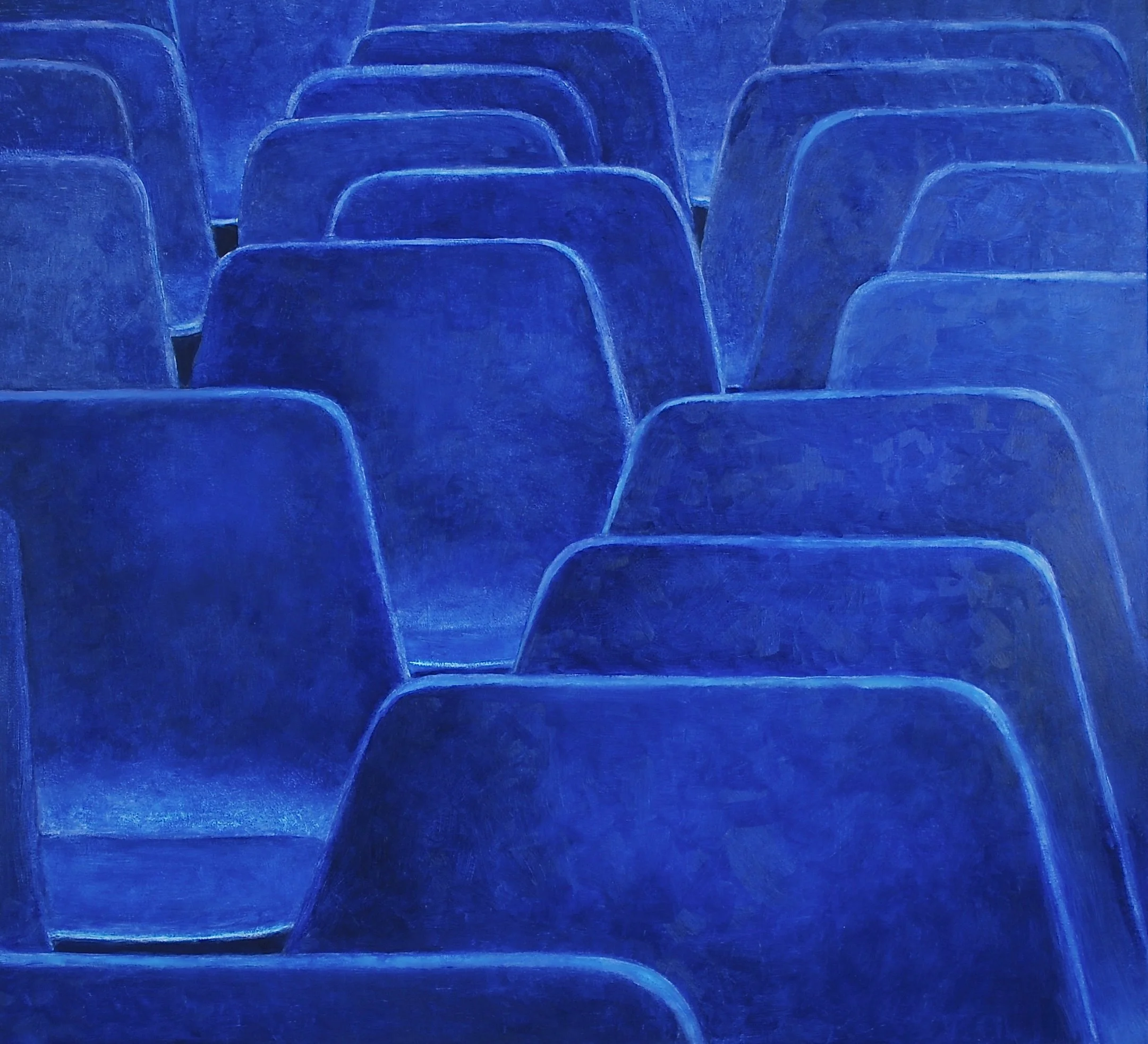

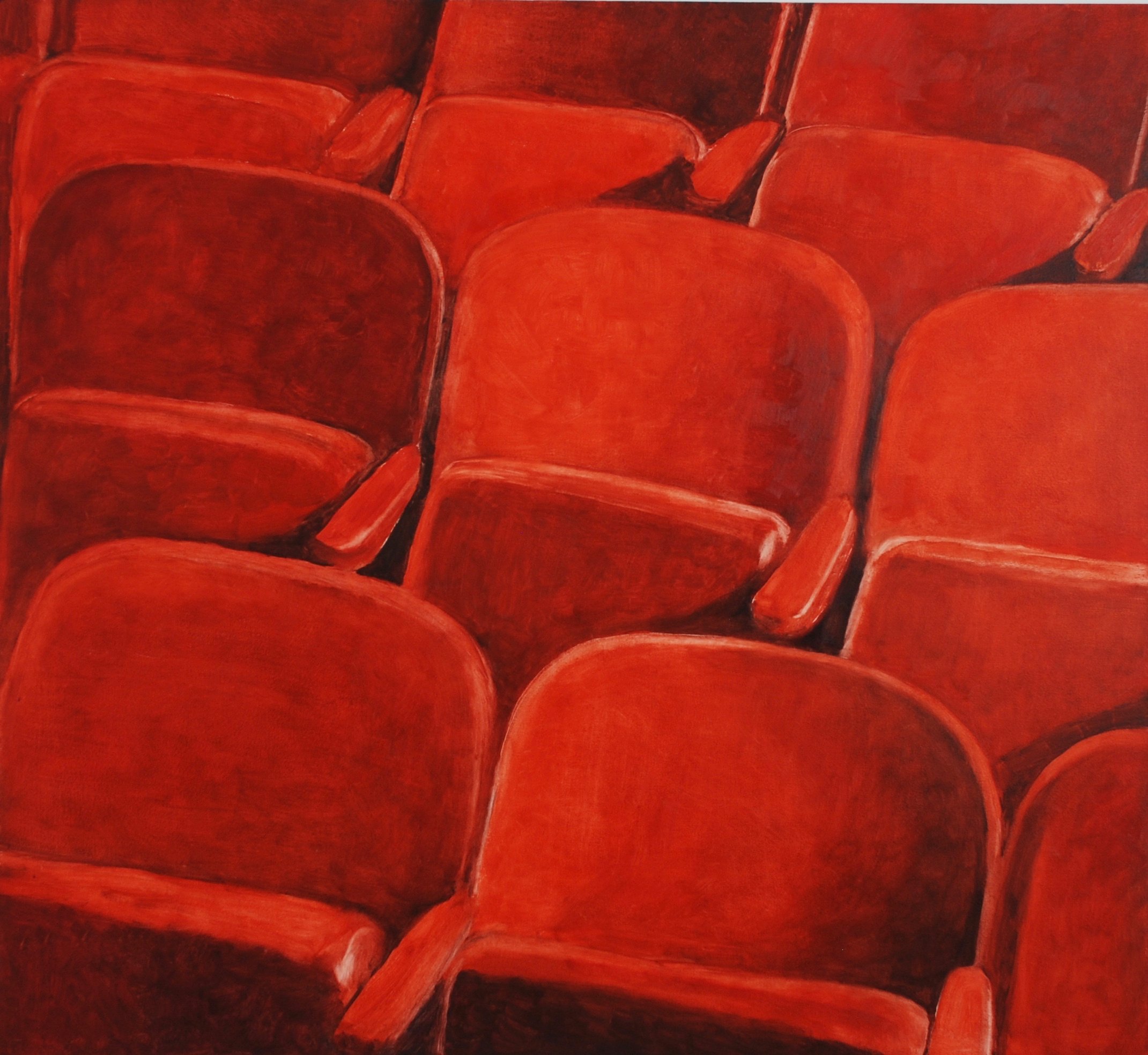
Sensing that only a few 'read' these paintings in an abstract sense, Jess recognises that many appreciate them because of their personal relationship to books, or because they resonate as symbols of literature, more pertinent because of our increasingly technological age. Whilst acknowledging this, she says 'Despite my awareness that books are literature, I avoid text or titles. I do not want them to be any certain book, and judged accordingly. By making my books nameless, I hope to allow every viewer to bring whatever book they choose to the painting. I like the openness of this.' She continues, ' themes tend to run through. Recently pages have no writing on them. This suggests that they are waiting for the viewer to imagine, or 'write' their own text. A connection with MA is also here, in the empty space on the pages, which give place and space to a pause.'
Thinking about her own painting practice, Jess notes a parallel with the act of reading, where solitude is necessary to fully experience the words, and this echos the artist's experience of being alone in the studio and absorbed in painting. In her 2021 solo exhibition at Blue Shop Cottage ‘Books from Boxes’ her work shows how a mindful concentration on simple objects can encompass a deeper and considered experience of being.
“Working from observation, the presence of light and shade feels inevitable,” says Cornwall-based painter Jess Allen. “I like this visual game of presence and absence.” Composing pared-back interior scenes featuring tableaus of silhouettes and shadow, the artist seeks to capture a moment in time without resorting to a conspicuous or distinct narrative. Natural light falls from above onto familiar domestic scenes, where closely cropped views of couches and stacks of books are overlayed with shadow figures – indeterminate and unnamed portraits that stand just out of view. Allen does not name these figures, instead hoping that the audience can impute their own experiences and desires on their indistinct forms. By using the interplay of light and shade, the artist elevates her subjects to an archetype or allegory, to be understood by her audience using their personal experiences Her true subject then is not any one person, but time itself, defined by the angle of the sun and the tilt of the earth’s axis. It is defined by omission, the length and distortion of shadows defining a particular instant which the artist has carefully and attentively recorded using her striking, muted style. Allen’s paintings are quietly compelling, their composition making them feel intimate. By placing light and shade at the centre of her practice, and elevating the consideration of shadows to become the fundamental element of her works, Allen has beautifully personalised the universal experience of time.”
— Art/Edit Magazine